

Long term community care strategy launches Hayat Pharmacy into the national spotlight during COVID-19 pandemic and beyond.
When you hear the word “visionary” thoughts of legendary products and services are sure to come to mind. Apple, Google, GE and Microsoft, among others, whose visions literally changed and improved billions of lives for the better. But, what about pharmacy?
“Visionary” is a word we hear often in pharmacy. Yet it’s a rare moment when we see it in action. That all changed when we sat down to talk with Dr. Hashim Zaibak, the founder and CEO of Wisconsin-based Hayat Pharmacy. We got to see, first hand, how this pharmacist’s vision transformed a single community pharmacy into 19 stores into 19 stores — and a household name in the news — within 10 years.
A Pharmacist’s People-Centric Vision Improves Communities’ Lives, Enhances Job Satisfaction and Builds a Roadmap for Long-term Success
It seems like only yesterday when Dr. Zaibak founded the first of Hayat’s family of pharmacies. In January of 2011, Hayat first opened its doors in a downtown Milwaukee medical building — in the heart of the inner city. The pharmacy wanted to do more for the community. To do better. “We wanted to help people live better and healthier lives,” recalls Dr. Zaibak. Through this inspiration, the pharmacy was aptly named Hayat, which means “life” in Arabic.
“We started working with the inner city of Milwaukee in some of the most underserved communities,” says Dr. Zaibak. The Hayat team set out to address special challenges that made healthcare management difficult for community members. “Transportation is an issue for many and copayments were another problem." Some people simply couldn’t afford all of their copayments at the same time. Just as challenging were health literacy issues that prevented people from understanding their therapies, as well as medication adherence.
Hayat didn’t give up on these patients. Instead, the pharmacy set out to solve these challenges with a strong focus on offering clinical services the community needed most. Hayat created a home delivery program that took prescription delivery services to the next level. “We also started offering accounts receivable to help them pay their copayments,” adds Dr. Zaibak. “We hosted one-on-one classes and medication therapy management sessions, and added medication synchronization.” The pharmacy also provided medication bubble packaging to solve patients’ adherence issues.
The clinical service solutions worked and patients began flocking to the pharmacy. To keep up with the demand, Hayat started rolling out more stores. And, not a moment too soon.
When a CVS pharmacy closed its doors in a local Hispanic community, customers faced the risk of therapy interruptions as they scrambled to find neighborhood alternatives. Hayat sprang into action by hiring pharmacy technicians from the now-shuttered CVS store to bridge care gaps for these displaced customers. Today, these pharmacy technicians continue to serve these customers, who happily followed them to the Hayat store. It was a win-win situation for the pharmacy technicians and the customers.
Outsmart Challenges Before They Happen
“If you think about it, every pharmacy owner in the business today are in business because they were successful at something,” says Dr. Zaibak. “When you ask them, ‘Was it easy?’, they’ll tell you, ‘No, it wasn’t. It was hard.’” In fact, he adds, if success was easy, 100 percent of the population would be successful 100 percent of the time. That’s why successful pharmacists learn how to outsmart challenges before they happen.
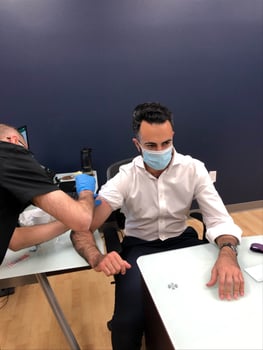
Challenges don’t just occur in business planning. They pop up in virtually any program a pharmacy sets out to implement. This includes clinical services, medication therapy management, synchronization, vaccinations — general and now COVID 19, POS, billing, reimbursement and beyond. Pharmacies need to see into the future and plan how to pivot and power through obstacles.
“There's going to be workflow challenges, scheduling, eligibility, and, oh my gosh, eligibility with COVID vaccine is a nightmare,” says Dr. Zaibak. “At the same time, the people who think of ways to overcome those challenges are the ones who become successful eventually.” The founders of companies like GE, Microsoft, Apple, Google are prime examples of outsmarting challenges, adds Dr. Zaibak. “They had a lot more challenges than we can think of and they were able to overcome them. They didn't say, ‘oh, this is too hard. I'm going to let other people do it.”
COVID-19: The Pandemic Proves that Planning Pays Off for the Community and the Pharmacy
When the COVID-19 pandemic swept the world, many of the most profitable healthcare organizations felt the financial pinch as routine services were forced to take a back seat in lieu of infection control. But, to get back to the business of keeping communities healthy, Hayat recognized the importance of reopening pathways to routine care by going back to basics: ensuring their communities’ immediate COVID-19 needs were being met through the right mix of clinical services. This included COVID-19 testing and vaccinations as soon as these services became available.
Hayat leveraged the Health Mart Atlas testing program, a partner program available through AAPA, to offer testing to patients and ensure seamless reimbursement management. “We’ve had days where we’ve done 30 tests and days where we’ve done 400,” says Dr. Zaibak. And, through proactive planning, the pharmacy registered for the COVID-19 vaccine program through the state of Wisconsin. “Our main clinical pharmacist is extremely active with the Pharmacy Society of Wisconsin. She’s been on top of it since day one. She pulled out all of the paperwork, got us the [vaccine] shipments and we started providing vaccinations at three locations.”
Hayat averages around 400 vaccinations a day with “peaks of 800 to 900 and valleys of about 150.”
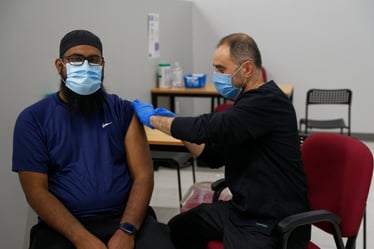
How can an independent pharmacy support so many daily vaccinations? Simple. By engaging the best team members right out of the gate. “The governor signed an executive order allowing certified pharmacy technicians to vaccinate,” says Dr. Zaibak. “They’ve been doing it since day one.” Not only does this benefit the volume of vaccinations available to the community, but it enables pharmacy technicians to grow and practice “at the top of their licenses.”
With its COVID-19 clinical services, Hayat noticed a continued increase in new patient referrals. But that’s not the only thing that increased. The pharmacy has become a household name in Wisconsin news media outlets. News agencies, such as ABC, CBS and Fox, regularly feature Hayat in vaccination stories. “We’re on the news at least once a week — sometimes multiple times a week,” says Dr. Zaibak. In fact, the pharmacy has become a trusted source of COVID-19 vaccination information for news agencies. When the state of Wisconsin releases a new vaccine update, “We get text messages from reporters asking, ‘What's your plan? How are you going to do this?”
Hayat: A ‘Big Picture’ Approach
While it seems like Hayat was an overnight success, Dr. Zaibak’s vision — and resulting strategies were the product of community focus, the decision to take risks and attention to growth and the “big picture.”
“Honestly, one of the challenges that many pharmacists and pharmacy owners face is looking at the return on investment and people,” says Dr. Zaibak. “Some people are looking at the return on investment per transaction, they want to make money, they want to make sure that they have a good return on investment with every single transaction. Then there are people who look at the big picture and say, ‘You know what? Maybe I can have the negative gross margin on some of the transactions as long as the full picture is that I'm growing and being more successful.”
Dr. Zaibak suggests focusing on the big picture. “Being conservative and just doing what we've been doing for the last 10, 20 or 30 years is not always a good idea.” Taking the risk might mean initiating something new, or doing something that might look like it's going to have a low return on investment initially. “Later, that new thing might open new doors for you. And remember, the most successful people in history have taken big risks.”
.png)